Failed Payment Recovery for Shopify Brands: 30-Day Playbook
Most Shopify subscription brands run the default dunning sequence and accept the recovery rate. Here is the 30-day playbook that pays better.
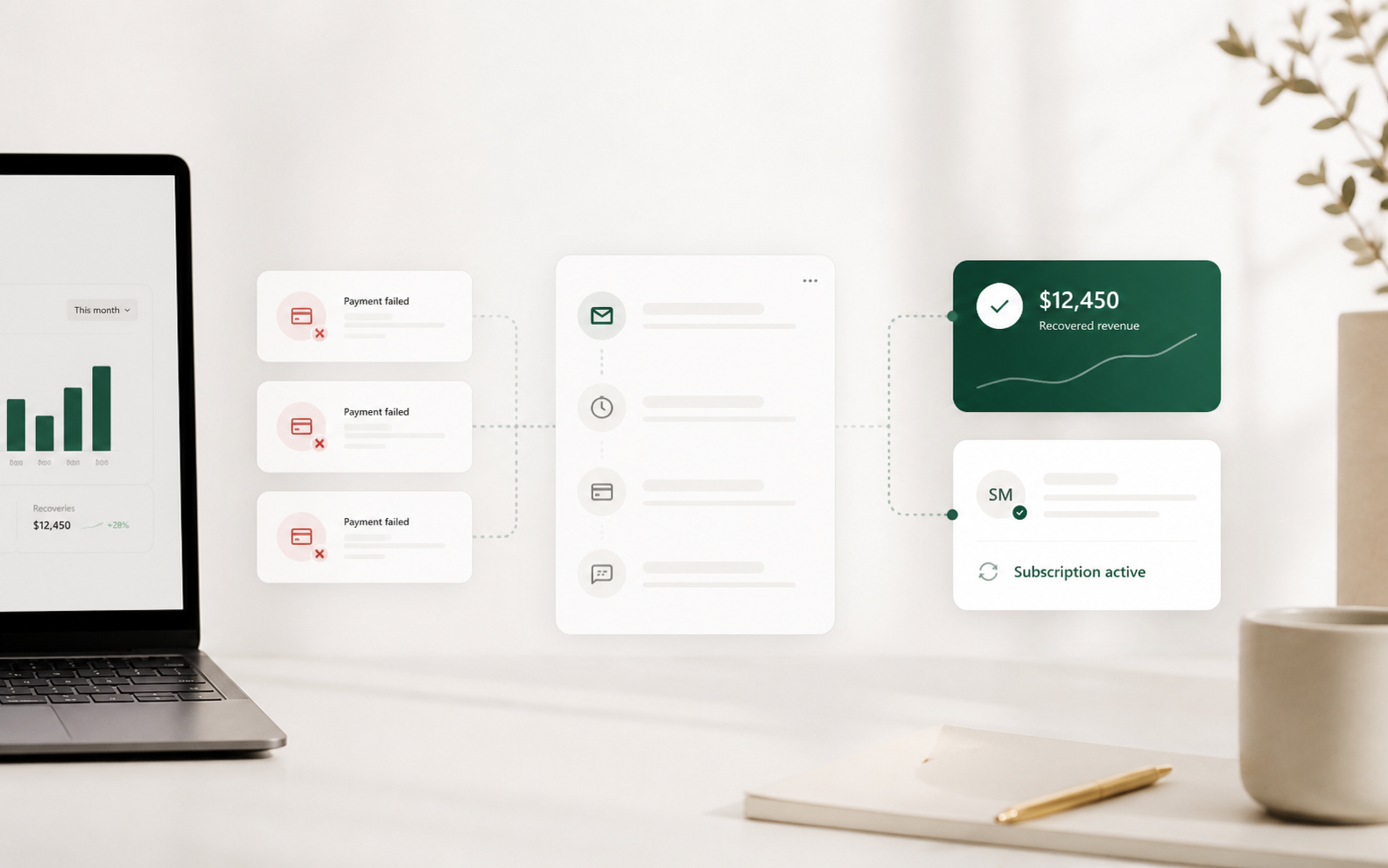
Why default dunning leaves money on the floor
If you run a DTC subscription brand on Shopify, your failed payment recovery flow is probably whatever Recharge or Stripe ships out of the box. Three retries over a week, three templated emails, then the subscription cancels. That sequence recovers a baseline percentage and stops there. The customers who do not respond in seven days become churn that nobody notices, because the dashboard shows them as cancelled, not lost.
This is the most fixable line item on a subscription P&L. According to Recurly's research on over 1,300 subscription businesses, involuntary churn from failed payments is preventable when the cadence is built around how declines actually behave. The brands that take recovery seriously do not buy a more expensive billing tool. They run a 30-day playbook that mixes automated retries with manual outreach for the customers worth the time.
What is actually failing, and why timing matters
Before designing a cadence, look at your decline reasons. The top three across DTC subscription billing are almost always insufficient funds, generic "declined," and temporary holds. All three are soft declines. The card still works. The customer still has a subscription. The money will probably show up if you wait for payday or the bank's nightly batch.
The greatest recovery rate for transactions occurs within a short time frame, two to seven days when the decline reason is Insufficient Funds. Recurly Research, 2024
Then there is the second category: expired cards, replaced cards, fraud holds. These are hard declines. No retry will ever resolve them. The customer has to take action. That action gap is where most preventable churn lives.
The implication is simple. Your retry logic should be aggressive on soft declines and silent on hard declines. Your communication should be aggressive on hard declines and silent on soft ones. Most default flows do the opposite, hitting customers with three "your payment failed" emails for an insufficient-funds decline that would have resolved on its own.
The 30-day hybrid playbook
The cadence below assumes a standard 30-day billing cycle. Adjust intervals if your cycle is shorter.
Days 1 through 7: silent retries on soft declines
1. Day 1, hour 2. First retry. Catches network errors and rate limits that resolved in minutes. 2. Day 3. Second retry. Crosses one weekend or one paycheck cycle for hourly workers. 3. Day 7. Third retry, ideally timed for the 1st or 15th of the month if your data shows clustering. Insufficient funds resolve when paychecks land, not when your cron job decides.
No customer email yet on soft declines. The card recovered without bothering them. That is the win. For hard declines, skip the silent retries and jump straight to Day 1 communication, because retrying a card that has been replaced is wasted gateway fees.
Days 8 through 14: light-touch automation
4. Day 8. First customer email. Friendly framing ("We had trouble with your last payment"), clear update link, no urgency yet. 5. Day 11. Fourth retry, paired with a second email if no card update has happened. 6. Day 14. Add SMS for customers who opted in. Open rates on transactional SMS run far higher than email, and the cost per message is trivial.
Days 15 through 30: human outreach for the customers worth it
This is where most brands stop and most revenue is left on the table. The remaining customers did not respond to four retries and three messages. Two segments matter here.
7. Day 17. Final automated email. Explicit consequence, specific cancellation date, one-tap update link. Catches procrastinators. 8. Day 21. Manual outreach for high-LTV customers. A real person, named in the from-line, sends a short note. Not from "support@," from "alex@." One paragraph. Offers help with a card update or a cycle skip if the customer is not ready to receive another box. 9. Day 28. Last chance personal note for the high-LTV segment. Same human, different angle. Ask if anything changed and whether a flavor swap or smaller box would work.
Where the LTV threshold sits
Human outreach pays when expected recovered LTV exceeds the labor cost of the touch. For most DTC subscription brands, that means manual outreach for any customer with at least three prior shipments or expected remaining LTV above $300. Below that threshold, the automated sequence does the work.
The math is straightforward. A CX teammate at $25 per hour spending five minutes on a personal note costs about $2 per touch. If that touch recovers a customer with $400 of remaining LTV at even a 10% lift over the automated baseline, the unit economics are obvious. Run it. The constraint is not whether the play works, it is whether anyone has time to execute it during BFCM week.
Copy patterns that perform
A few rules that hold across the cadence.
- Friendly framing on the first touch. "We had trouble with your last charge" beats "Your payment failed." The first sounds like a small bug, the second sounds like an accusation.
- One CTA per email. A pre-authenticated update link, nothing else. Multiple links, FAQs, and product photos cut conversion.
- Name the consequence on the final automated touch. "Your next shipment on April 12 will be cancelled if we cannot process payment by April 8." Vague timing kills urgency.
- Manual outreach is one paragraph and ends with a question. "Did your card change, or is there something else going on?" The reply rate is the win, even if the answer is "cancel me." That information is still useful.
What to measure
If you cannot tell which step in the cadence is recovering revenue, you cannot improve it. Track three numbers, separately, every week.
- Recovery rate by decline reason. Soft and hard should live on different dashboards. Mixing them hides the real problem because soft-decline recovery dominates the average and masks the hard-decline gap where most preventable churn actually sits.
- Recovery rate by day of cadence. Day 1 retry recovery is your baseline. Anything above that is what your cadence is actually adding. If your Day 14 SMS is recovering nothing, kill it.
- LTV recovered per manual touch. The number that proves the human work is worth keeping in the budget when finance asks why CX has a fractional headcount on retention duty.
Conclusion
The default Recharge or Stripe sequence is fine for the easy half of failed payments. The other half, the customers who actually need a nudge or a human, are where retention dollars hide. Run the 30-day cadence, segment by decline reason, and let the high-LTV cohort hear from a real person. Palomar pulls Shopify, Recharge, and support signals into one view so the team running this playbook can see who is failing, who is at risk, and who is worth the manual touch. If that is the kind of operating layer you are building toward, join the waitlist and we will show you what your data already says.