AI Handles 30% of Your Tickets. Don't Cut the CX Team.
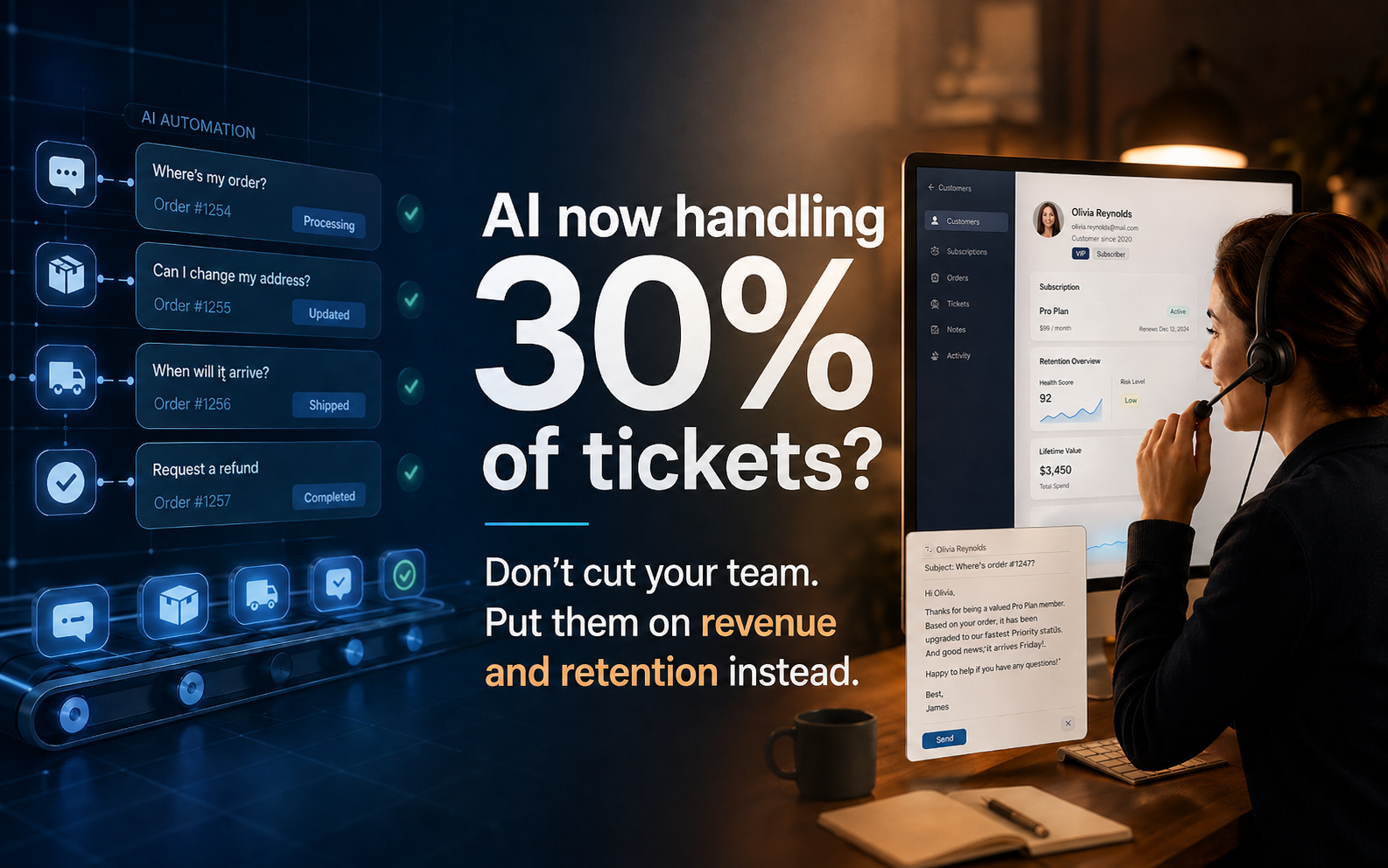
AI is deflecting 30% of DTC support tickets. The reflex is to cut headcount. The smarter play is pointing the team at subscription saves and failed payments.
The wrong lesson from a 30% deflection rate
Your AI agent just closed out a Tuesday handling 30% of inbound tickets. Order status, return windows, "where is my package," shipping address changes. Nobody escalated. CSAT held. The CFO has noticed and the next finance review has a slide about "right-sizing CX." That is the obvious move and it is the wrong one.
The Salesforce 2025 State of Service report, surveying 6,500 service professionals, found AI is now resolving roughly 30% of customer service cases, with leaders expecting that share to hit 50% by 2027. For a DTC brand on Shopify with a subscription program, that math points at a real customer support roi opportunity, but not the one most leadership decks assume. The freed capacity is worth more pointed at retention than removed from the budget. Klarna already ran the layoff version of this experiment in public, and walked it back in 2025.
What Klarna learned, and why DTC stakes are higher
In February 2024, Klarna announced its OpenAI-built assistant was doing the work of 700 full-time agents and projected to add $40M in profit. Headlines were everywhere. Fifteen months later, CEO Sebastian Siemiatkowski told Bloomberg the company had gone too far. His exact framing: cost had become "a too predominant evaluation factor" and the result was lower quality. Klarna started hiring humans back as remote on-demand agents.
Read that carefully. The chatbot still handles two-thirds of inquiries. Resolution time is still 82% faster. The AI part worked. What failed was the assumption that AI deflection equals headcount reduction. The customers Klarna kept routing to bots were the ones with the highest stakes and the most leverage on lifetime value.
If anything, DTC stakes are higher. A fintech customer who churns over a bad chatbot interaction can be reacquired with a promo. A subscription beverage customer who churns over a botched delivery question, after you spent $68 to acquire them, never comes back at the same unit economics. According to Shopify's commerce data, DTC CAC has climbed roughly 40% in the last two years. Retention is the entire game. Treating tier-1 deflection as an excuse to cut the only people who can save high-value subscribers is how you set fire to next year's revenue.
What the freed capacity is actually worth
Forget fully loaded salary math for a minute. The relevant ecommerce ticket cost benchmark sits between $2 and $8 per contact per industry data, far below SaaS support costs. Tickets are cheap. The customers behind them are not.
Now look at what one agent can produce when their day is not consumed by order-status triage. Each of these is sourced from real subscription benchmarks, not invented:
- Failed payment outreach. Roughly 10% of subscription revenue is lost to involuntary churn each year, per Recurly's 2024 State of Subscriptions. Recurly customers using recovery tooling save 72% of at-risk subscribers and add a median 141 days to subscription life. Stripe's automated retries alone recover a fraction of that. The marginal lift comes from a human emailing or calling the customer.
- Subscription save flows. Recharge brands using cancellation prevention have reported active churn reductions up to 44%. Loop Subscriptions case studies show DTC brands hitting save rates above 30% on customers who hit the cancel button.
- VIP intervention. Top-decile customers with a recent negative contact churn quietly if nobody reaches out. A 10-minute manager-level call saves a multi-year LTV at a cost that does not register on a P&L.
- Win-back. Recurly's 2025 report found 20% of new subscribers in 2024 were return acquisitions, customers who had canceled and came back through outreach.
Your agents already have the data nobody else does
This part gets skipped in most "AI is taking support jobs" coverage. Your CX team already knows which customers just contacted about a damaged subscription box, who is on their third failed payment, who downgraded after BFCM, who threatened to cancel and was talked off the ledge. That context lives in tickets, in agent notes, in Slack threads, scattered across Shopify, your subscription platform, Klaviyo, and the helpdesk. It does not live in any one tool.
A growth team running a generic win-back flow does not have that context. A standalone dunning vendor does not have that context. The support agent who took the original ticket does. The default playbook spends that knowledge on closing tier-1 cases instead of pointing it at the customers who matter most.
When you redeploy after AI deflection, you are not turning a cost line into a sales team. You are taking the only people in your company who already know which subscribers are about to leave, and giving them time to do something about it.
The DTC redeployment playbook
If AI is genuinely handling 30% of inbound, here is what to do with the freed capacity. Do not skip the measurement step.
1. Measure what your AI agent is actually deflecting. Not "tickets touched." Tickets resolved without escalation, without rework, and with CSAT intact. If the bot is offloading volume but driving a second contact, the deflection number is fake. 2. Tier customers by LTV, not ticket count. Pull Shopify, subscription, and payment data to identify the top quartile by LTV and the bottom quartile by health. Both groups need human time. The middle is where the AI earns its keep. 3. Stand up three plays, each with a dollar target. Failed payment outreach, cancellation save calls, VIP intervention. Each gets a daily contact target, a script, and a recovery dollar goal. Track dollars, not dials. 4. Rewrite the QBR slide. Replace ticket volume and FRT with revenue retained, churn prevented, and LTV extended. Those are the numbers that reframe the team from cost center to revenue contributor. 5. Hold the line on high-stakes contacts. Klarna's reversal happened because automated handling degraded the interactions that mattered most. Route VIP and cancellation contacts to humans by default. The AI keeps doing order-status work.
The first quarter of doing this gives Nancy the data to defend the team. The second quarter gives her the data to grow it.
Conclusion
Cutting CX headcount when AI deflection hits 30% is the move that looks responsible on a spreadsheet and quietly costs you next year's subscription revenue. The DTC brands that compound through the next two years are the ones treating AI deflection as freed capacity to point at retention work, not as a line to reclaim. We built Palomar around this thesis: support is a revenue engine when the team has the data and the time to act on it. If that is the direction you are going, join the waitlist and we will show you what your subscriber data already says.